What Is RNU2-2? A Medical Information Guide for Families
A plain-language guide to the gene, the dominant and recessive forms of ReNU2, and what researchers have learned so far.

RNU2-2-related neurodevelopmental disorder, often called ReNU2, is a newly recognized genetic condition. It can affect development, learning, movement, communication, and seizure activity. People with ReNU2 can have very different abilities and support needs.
For many families, a diagnosis comes after years of searching. It may explain some of their child’s experiences, but it cannot predict every challenge their child will face or every skill they will develop.
Researchers first described the dominant form in a major study published in April 2025. Three studies published in March 2026 greatly expanded what is known, including the identification of a recessive form. This is recent research, and our understanding will continue to grow.
The gene behind ReNU2
RNU2-2 is a small gene that makes a molecule called U2-2 small nuclear RNA, or U2-2 snRNA. Unlike many genes, RNU2-2 does not make a protein.
U2-2 is part of the spliceosome. When a cell reads a gene, it first makes a draft RNA message. The spliceosome helps prepare that message by removing certain sections and joining others together. This process is called splicing.
Another gene, RNU2-1, makes a closely related U2 RNA molecule. Researchers are investigating how these RNA molecules work and how different changes in RNU2-2 lead to disease. They have found biological differences between some dominant and recessive variants, but the full process is not yet understood. In particular, it would be inaccurate to say that researchers have established the same widespread splicing errors in every person with ReNU2.
Why wasn’t RNU2-2 recognized sooner?
RNU2-2 was previously labeled a pseudogene—a gene thought to be inactive. Researchers have since shown that it is functional and that certain changes in it cause a neurodevelopmental disorder.
It is also a non-protein-coding gene. Many older genetic tests and analysis systems focused on genes that make proteins and did not adequately assess RNU2-2. This helps explain why some affected people remained undiagnosed despite previous genetic testing.
Two forms of RNU2-2-related disorder
Researchers have identified dominant and recessive forms of ReNU2. These words describe the genetic findings. They do not tell you, on their own, how a child will develop or what support they will need.
Dominant ReNU2
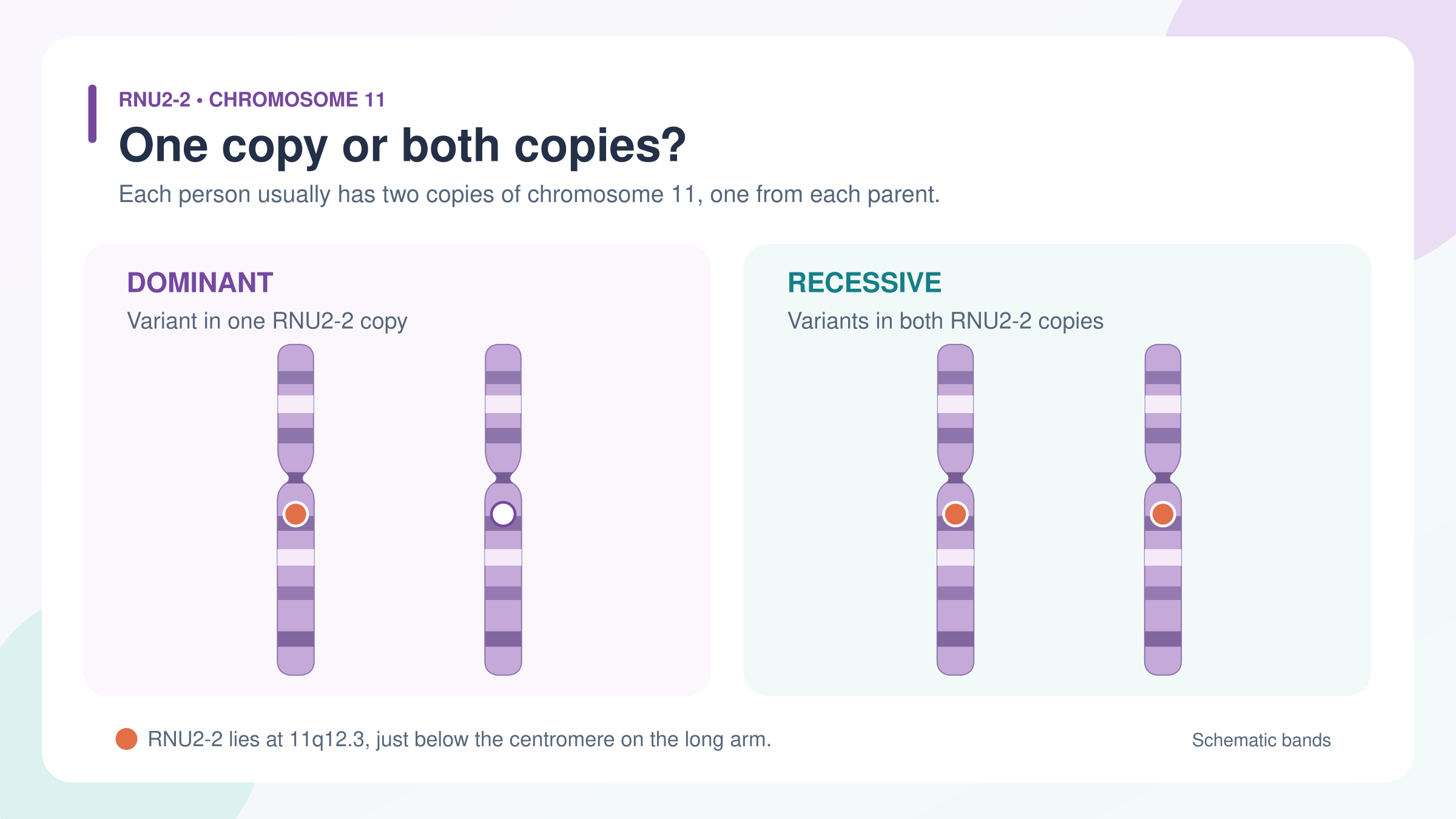
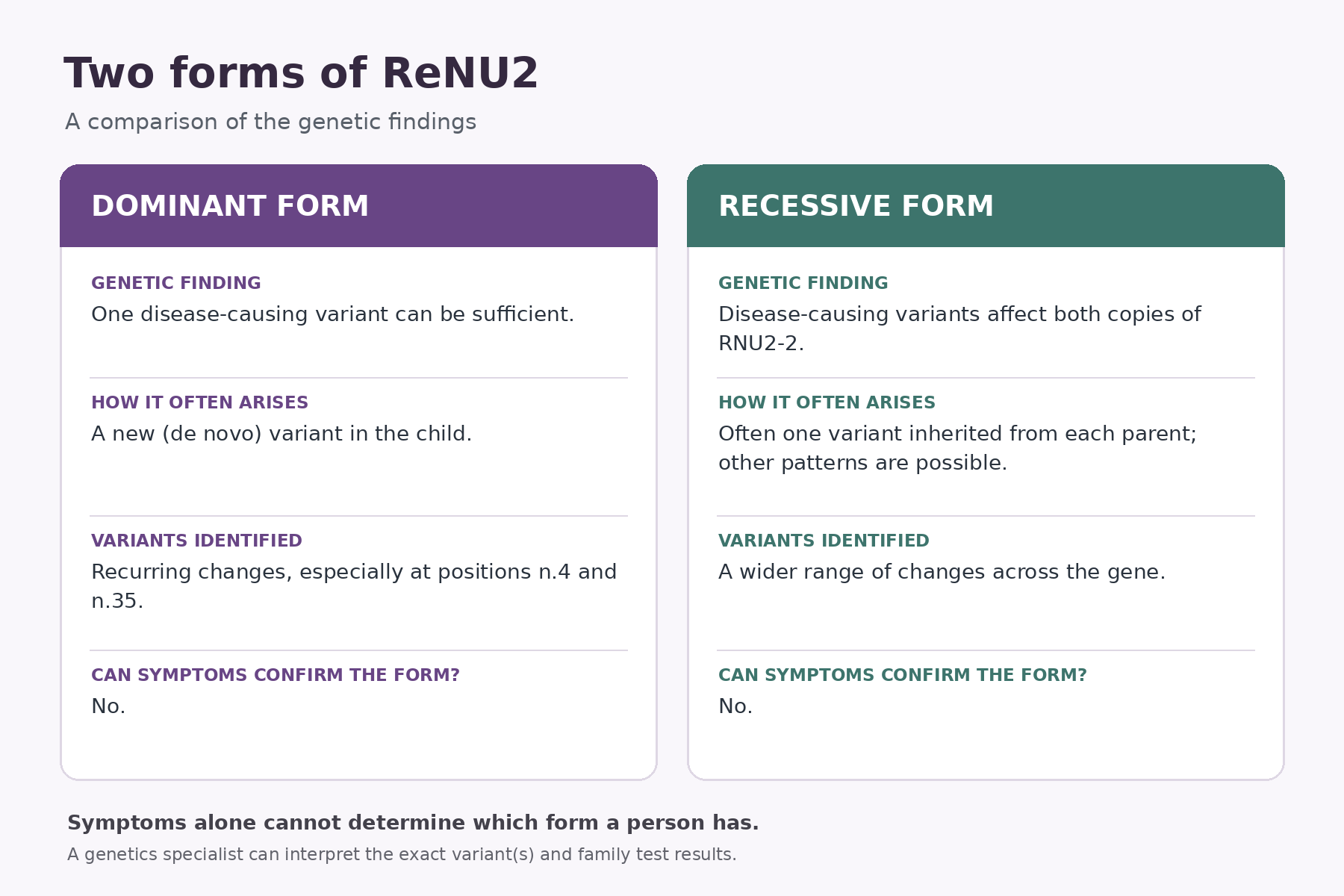
In the dominant form, one particular disease-causing change in RNU2-2 can be enough to cause the disorder. The first study identified recurring changes at positions n.4 and n.35 of the gene.
Most dominant variants described so far arose de novo. This means the change occurred for the first time in the child and was not found in either parent’s tested sample. The original study described developmental and intellectual disability, epilepsy, low muscle tone, autistic features, small head size in some individuals, and episodes of hyperventilation. Seizures were a particularly prominent finding in that initial group.
Recessive ReNU2
In the recessive form, disease-causing changes affect both copies of RNU2-2. A child may inherit one changed copy from each parent. Other patterns have also been reported, so a geneticist needs to interpret the child’s and, where available, the parents’ results.
The recessive form was identified in research published in 2026. Its disease-causing variants can occur at many different positions in the gene. Developmental disability and epilepsy are prominent in the published groups. Differences in movement and muscle tone have also been described. Parents who carry one recessive variant are generally unaffected.
A de novo variant does not always mean a dominant diagnosis. In some recessive cases, a newly arising change is one of the two disease-causing variants. The exact variants and whether they affect one or both copies determine how the result is interpreted.
Can symptoms tell you which form a child has?
No. Researchers have observed some differences between groups, but the forms overlap. A child’s seizure type, movement pattern, speech, or level of support needs cannot reliably establish whether their condition is dominant or recessive. One 2026 study suggests that the effects of different RNU2-2 variants may form a continuum rather than two completely separate clinical groups.
Signs and symptoms reported so far
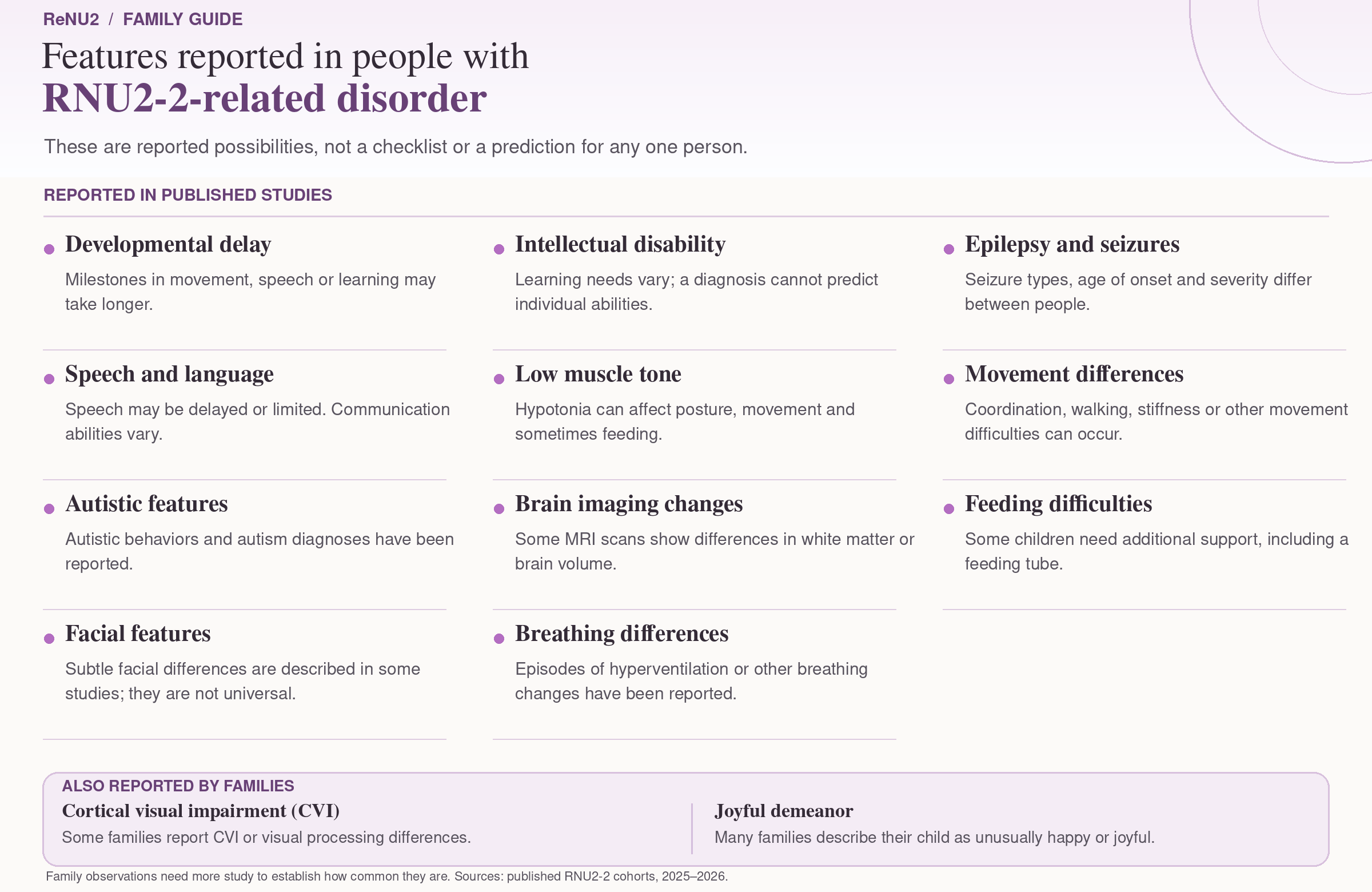
The features below have been reported in people with RNU2-2-related disorders. A person will not necessarily have every feature. Studies have identified a growing number of affected people, but researchers still need to learn more about the full range of experiences across ages and genetic variants.
Development and learning
Developmental delay is common. Children may take longer to develop movement, communication, and learning skills. Intellectual disability has also been frequently reported. A diagnosis, however, cannot tell a family exactly which skills their child will gain.
Seizures and epilepsy
Epilepsy is common in the published groups and can be difficult to manage. The age when seizures begin, seizure types, frequency, and severity vary. The initial dominant study found severe and complex seizures in its participants; later studies described epilepsy across both forms. A child’s individual seizure history matters more for their care than a study average. ReNU2 is described as a Developmental epileptic encephalopathy. DEE’s are complex pediatric epilepsy disorders that can profoundly impact neurological development in children.
Movement and muscle tone
Low muscle tone, delayed motor skills, stiffness or spasticity, and other movement difficulties have been reported. Researchers have also documented movement disorders in some affected people. If a child develops a new or changing movement, their medical team can assess what it is and whether another explanation needs to be considered.
Speech and communication
Speech and communication abilities vary. Some affected people have very little spoken language, while others develop more speech. Spoken language does not capture everything a person understands or every way they communicate. Communication may include speech, gestures, signs, pictures, or assistive technology.
Breathing differences
Hyperventilation—episodes of unusually rapid or deep breathing—was reported in the original dominant group. A new or concerning breathing change should be assessed by a clinician rather than assumed to be part of ReNU2.
Other findings
Studies have also reported feeding difficulties, autistic features, differences in head growth, and changes on brain imaging in some people. Findings vary. Families may notice concerns that researchers have not yet studied enough to establish whether they are commonly associated with ReNU2.
How common is ReNU2?
The 2026 studies found that recessive RNU2-2-related disorder is an unexpectedly frequent diagnosis among people investigated for neurodevelopmental disorders. In one analysis, researchers estimated that it accounts for approximately 10% of families with a recessive neurodevelopmental disorder that is currently diagnosable through sequencing. Another study found it was the most frequent recessive neurodevelopmental diagnosis in that study’s cohort.
These figures do not mean that 10% of all children with developmental disabilities have ReNU2. They describe particular research populations and diagnostic categories. The number of affected people worldwide is not yet known, and access to genetic testing varies widely.
How is ReNU2 diagnosed?
A diagnosis involves finding a disease-causing RNU2-2 variant, or two variants in the recessive form, and interpreting that finding alongside the person’s medical and developmental history.
Whole-genome sequencing that includes analysis of RNU2-2 has been the key way researchers and clinicians have identified affected people. Gene panels and exome tests do not adequately assess this small, non-protein-coding gene. A Whole-genome test also needs the appropriate analysis: having had genome sequencing does not, by itself, prove that RNU2-2 was checked and interpreted using current knowledge.
If a child previously had genetic testing without a diagnosis, their genetics team can review which test was done, whether RNU2-2 was assessed, and whether reanalysis or further testing would be useful.
A report describing a variant of uncertain significance is not the same as a confirmed diagnosis. A rare change in RNU2-2 does not automatically explain a person’s symptoms. The precise variant, available evidence, and sometimes testing of parents or other relatives all help specialists interpret the result.
What about RNA testing?
Researchers have used blood samples to measure U2-2 RNA and compare it with the closely related U2-1 RNA. In some people with recessive RNU2-2-related disorder, these measurements have helped researchers understand the effects of their variants.
This is valuable research, but it is not a routine blood test that every family needs to obtain. An RNA measurement on its own does not replace genetic testing and expert interpretation.
What does the diagnosis mean for relatives?
The answer depends on the child’s specific genetic findings.
For most families whose child has a confirmed de novo dominant RNU2-2 variant, having another child with ReNU2 is highly unlikely. De novo means the change arose for the first time in the child and was not found in either parent’s tested sample. A genetic counselor can explain the small remaining uncertainty and what the family’s results mean for a future pregnancy. This statement describes the usual expectation for an apparently de novo variant; it is not an RNU2-2-specific measured recurrence rate.
In the recessive form, if both parents carry a disease-causing RNU2-2 variant, each pregnancy has a 25% chance of a child inheriting both variants. Other combinations of results may have different implications.
A genetics team can explain whether testing relatives would be helpful and provide guidance based on the family’s actual results.
What do researchers still need to learn?
Identifying RNU2-2 as a disease-causing gene was a major advance. Important questions remain, including:
How the condition changes across childhood and adulthood
Why people with RNU2-2 variants have different symptoms and abilities
Which reported concerns are part of ReNU2 and how often they occur
How particular variants affect cells and development
Which outcomes matter most to affected people and families
How to measure meaningful change in future studies
Which approaches might eventually improve symptoms or address the underlying disorder
There is currently no established treatment that corrects the underlying RNU2-2 change. Care addresses each person’s symptoms, development, communication, health, and quality of life. An early laboratory result should not be presented as a treatment proven to work in people.
Understanding your child’s genetic report
These questions can help you discuss the report with the clinician who ordered or interpreted it:
What is the exact RNU2-2 variant or pair of variants?
Is the finding considered disease-causing, likely disease-causing, or uncertain?
Does the result support a dominant or recessive diagnosis? How was that determined?
Would testing parents or other relatives help clarify the finding?
Which of my child’s medical findings may be related to ReNU2, and which need separate evaluation?
Should this result be reviewed again as research develops?
Ask for a copy of the report and an explanation you can share with the rest of your child’s care team.
A note for families
Research articles describe groups of people. Your child is an individual. A feature that is common in a study is not inevitable for your child, and an ability that was uncommon in an early study is not impossible.
A diagnosis can offer an explanation and connect you with other families. It does not place a ceiling on what your child can learn or how they can participate in the world.
Read the research
The original study describing dominant RNU2-2-related disorder (2025)
Study describing clinical and biological findings in the recessive form (2026)
Large study examining dominant and recessive RNU2-2 variants (2026)
This page provides general information, not medical advice, diagnosis, or treatment. Always follow the guidance of your child’s physicians and specialists. It is not a substitute for their care. In a medical emergency, call 911 in the United States or your local emergency number.
Research reviewed September 2026.