
Preparing for School
Helping your child be understood, supported, and ready to learn
Starting school—or moving into a new classroom—can bring both hope and uncertainty. For children with an RNU2-2-related disorder, learning needs may involve communication, movement, vision, sensory processing, attention, health, behavior, or daily living skills.
No two children with ReNU2 are exactly alike. A diagnosis can help explain your child’s needs, but educational planning should always be based on your child’s individual strengths, challenges, and goals.
You know your child best. Your observations, priorities, and concerns are an essential part of the school-planning process.
Before School Begins: Learn How the System Works
Special-education systems can feel overwhelming, especially when families are encountering unfamiliar terms, evaluations, eligibility requirements, and formal meetings for the first time.
In the United States, children from birth through age two may receive services through their state’s Early Intervention program. As a child approaches age three, the family and early-intervention team should begin planning for the transition to preschool or other appropriate services.
School-based services are not automatically an extension of Early Intervention. Children generally need to be evaluated and found eligible under the school system’s requirements.
The special-education process generally includes:
A child is referred for an evaluation.
The school evaluates the child in all suspected areas of need.
The family and school review the results and determine eligibility.
If the child is eligible, the team develops an Individualized Education Program, or IEP.
The school provides the services, supports, and accommodations included in the plan.
The team measures the child’s progress and reviews the IEP at least annually.
The child is reevaluated periodically—or sooner when circumstances require it.
Parents are members of the team throughout this process. You do not have to wait until your child begins school or is struggling in a classroom to start asking questions.
Contact your local school district’s special-education or Child Find office well before your child’s expected start date and ask:
How and when should I request an evaluation?
What documents or medical information should I provide?
Which areas will be evaluated?
What are the required timelines?
How is eligibility determined?
What preschool or school options are available?
How will the team plan for my child’s communication, health, safety, mobility, and accessibility needs?
What happens if my child is not found eligible?
Families outside the United States should contact their local education authority or disability organization to learn how early-years and special-education services operate in their country.
Learn the 10 Basic Steps in Special Education
Begin With a Complete Evaluation
A thorough evaluation helps the school understand how your child learns and what support they may need. The evaluation should look beyond academic performance and consider every area where your child may need help.
Depending on your child’s needs, evaluations may include:
Cognitive and developmental functioning
Speech, language, and communication
Occupational and physical therapy needs
Fine- and gross-motor skills
Functional vision, including cortical or cerebral visual impairment
Hearing
Sensory processing and regulation
Assistive technology and augmentative and alternative communication
Social, emotional, and behavioral functioning
Adaptive and daily living skills
Academic achievement
Feeding, mobility, positioning, and personal-care needs
Ask the evaluators to explain the results in plain language, including how each finding affects your child’s ability to participate and learn at school. A score alone does not provide a complete picture.
If you believe an important area was missed, ask for it to be evaluated.
Build a Plan Around the Whole Child
Your child’s educational plan—whether it is called an IEP, EHCP, individual learning plan, or something else in your country—should describe your child as an individual.
A strong plan should include:
Your child’s strengths, interests, and motivators
Present levels of academic and functional performance
Specific and measurable goals
Specially designed instruction
Related services and therapies
Communication supports
Assistive technology
Accommodations and environmental modifications
Health, safety, and emergency procedures
A clear method for measuring and reporting progress
Support your child needs to participate with peers
Training or consultation needed by school staff
Goals should be meaningful and functional—not based only on what is easiest to measure. Ask how each proposed goal will improve your child’s communication, independence, participation, safety, relationships, or access to learning.
Consider Communication in Every Setting
A child’s ability to communicate can change depending on the setting, communication partner, fatigue level, or amount of support provided.
The school team should understand:
How your child communicates wants, needs, choices, discomfort, and refusal
Whether your child uses speech, signs, gestures, pictures, a communication device, or a combination
How much processing time your child needs
How adults should present questions or instructions
What helps your child initiate communication
How communication supports will remain available throughout the entire day
How staff will recognize pain, illness, distress, or possible seizure activity
Communication is more than requesting preferred items. Children need a way to ask questions, make comments, express emotions, refuse, seek help, and participate socially.
If your child uses augmentative and alternative communication, or AAC, it should be available across classrooms, therapies, meals, transportation, recreation, and emergency situations—not limited to speech therapy sessions.
Accommodations That May Help
Select accommodations based on your child’s documented needs. Possible supports may include:
Extra time to process information and respond
Short, clearly stated directions
Visual schedules and first/then supports
Instructions presented in more than one way
Tasks broken into manageable steps
Demonstration before independent attempts
Repetition and opportunities to practice
Reduced visual or auditory clutter
Movement, sensory, or rest breaks
Alternative seating, positioning, or adapted equipment
Large-print, high-contrast, or simplified visual materials
Access to AAC and assistive technology throughout the day
Alternative ways to answer questions or demonstrate knowledge
Adapted physical education
Support during transitions
A quiet or low-stimulation space
Additional time for meals, mobility, or personal care
Adult support when required for safety and meaningful participation
Accommodations provide access. They should not unnecessarily lower expectations or prevent a child from receiving appropriate instruction.
Plan for Health and Safety
If your child has epilepsy, feeding difficulties, mobility needs, allergies, or other medical concerns, ask the school to develop a written health and emergency plan.
For a child with seizures, this may include:
A current seizure action plan
Clear instructions for administering rescue medication
Staff trained to recognize and respond to the child’s seizure types
Guidance about when to call emergency services
Safe storage and immediate availability of medication
A plan for field trips, transportation, after-school activities, and substitute staff
A process for notifying the family after seizure activity
Instructions for recovery and return to learning
Emergency information should be easy for appropriate staff to access while still protecting your child’s privacy.
Ask how the plan will be communicated to teachers, nurses, transportation staff, aides, substitutes, and anyone else responsible for your child.
Prepare for School Meetings
You do not need to arrive at a meeting with every answer. It helps, however, to identify your most important concerns and priorities beforehand.
Before the Meeting
Request copies of evaluations and proposed documents in advance.
Review previous goals and progress reports.
Write down your questions and concerns.
Identify your top priorities for the coming year.
Gather relevant reports from outside providers.
Ask who will attend and what each person’s role will be.
Invite a support person, advocate, therapist, or other knowledgeable professional when appropriate.
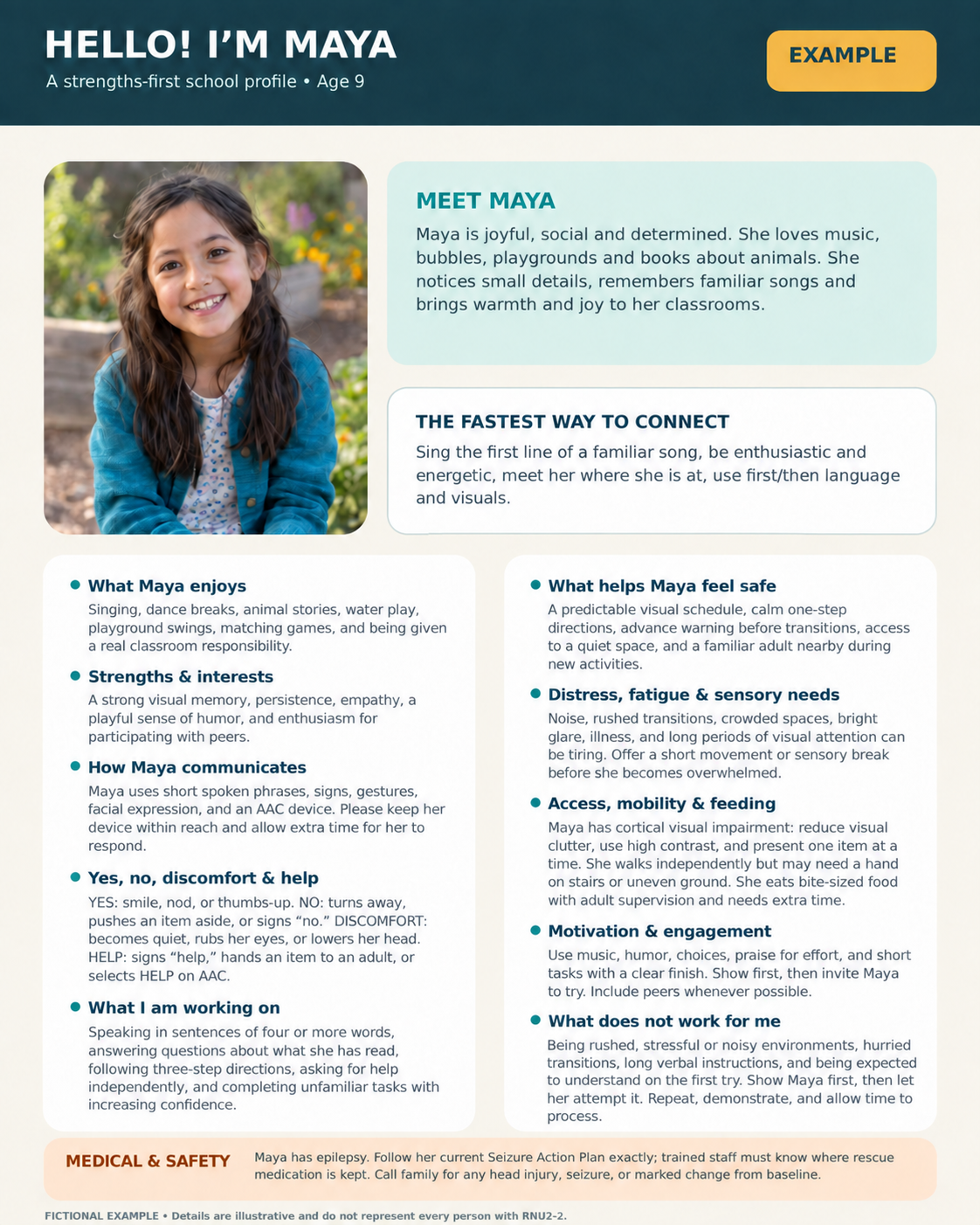
Consider preparing a short “About Me” page introducing your child.
During the Meeting
Begin with your child’s strengths and what motivates them.
Ask team members to explain unfamiliar terms.
Request specific examples rather than accepting vague descriptions.
Ask who will provide each service, where it will take place, how often it will be provided, and for how long.
Discuss how progress will be measured and shared with you.
Make sure health, communication, accessibility, and safety needs are addressed.
Take notes or ask someone attending with you to do so.
Request another meeting if there is not enough time to address important issues.
After the Meeting
Review the written plan carefully.
Confirm that it reflects what the team discussed.
Keep copies of evaluations, plans, progress reports, correspondence, and meeting notes.
Ask questions in writing when something is unclear.
Monitor whether agreed-upon services and accommodations are being provided.
Request a meeting if the plan is not working or your child’s needs change.
Create a One-Page Introduction to Your Child
A short, family-created profile can help teachers and support staff connect with your child from the beginning.
Consider including:
A photograph
Strengths, interests, and favorite activities
How your child communicates
The best ways to engage and teach your child
Signs that your child is overwhelmed, tired, unwell, or in pain
What helps during transitions
Important sensory, vision, mobility, or medical needs
Strategies that work well
Approaches that do not work
Current goals
Emergency information and key contacts
This profile does not replace the formal educational or health plan. It gives staff a quick, human introduction to the child behind the paperwork.

Keep Communication Consistent
A simple home–school communication system can help families and educators recognize patterns, celebrate progress, and respond to emerging concerns.
Useful information may include:
Sleep or significant health changes
Seizure activity
Medication changes that may affect the school day
Communication successes
New skills or areas of difficulty
Meals, hydration, or toileting when relevant
Activities or strategies that worked especially well
Upcoming changes that may affect the child
Agree on what needs to be communicated, how often, and by whom. Communication should be meaningful and manageable—not an additional burden for families or educators.
Getting Help From a Parent Center or Educational Advocate
You do not have to navigate the educational system alone.
Start With Your Parent Center
Every U.S. state has at least one federally funded Parent Training and Information Center. These centers help families understand evaluations, eligibility, IEPs, accommodations, parent rights, and dispute-resolution options. Assistance is generally available at no cost.
A Parent Center may be able to:
Explain the special-education process in your state
Help you understand evaluation reports and school documents
Help you prepare for an IEP meeting
Provide workshops, sample letters, and planning tools
Explain your options when you disagree with the school
Refer you to additional advocacy or legal resources
Find Your State’s Parent Center
When an Educational Advocate May Help
An educational or special-education advocate helps families understand the system and participate effectively in educational planning.
An advocate may review records, help identify concerns, prepare a family for meetings, attend meetings, explain possible options, and help keep discussions focused on the child’s needs.
You may want additional advocacy support if:
You are entering the process for the first time and feel unsure how to prepare.
Your child’s needs are complex or the school does not fully understand them.
Evaluations do not appear to reflect your child accurately.
Recommended services or accommodations are unclear or insufficient.
The school is not implementing the written plan.
Meetings have become confusing, unproductive, or adversarial.
You need help understanding your rights and available options.
An advocate does not replace your voice. A good advocate helps you understand the process, communicate your concerns clearly, and remain meaningfully involved in decisions about your child.
Choosing an Advocate Carefully
Advocates may have very different levels of training and experience. Before hiring someone, ask:
What training and experience do you have in special education?
Have you worked with children who have complex communication, neurological, sensory, visual, or medical needs?
Are you familiar with my state's laws and procedures?
How do you approach collaboration and disagreement with school teams?
Will you review my child’s records before the meeting?
What services do you provide, and what are your fees?
Can you provide references?
When would you recommend involving a special-education attorney?
Read the Guide to Educational Advocates
Families may also search the Council of Parent Attorneys and Advocates directory. A directory listing should be treated as a starting point—not as a guarantee of a person’s qualifications or suitability for your family.
Search for an Advocate or Attorney
When You Have Concerns
Raise concerns early and put important requests in writing. Describe what you are seeing, explain how it affects your child’s access to education, and state what action you are requesting.
If the team disagrees, ask:
What information was used to make this decision?
What alternatives were considered?
How will the school address the underlying need?
How and when will progress be reviewed?
Can the school provide its decision and reasoning in writing?
In the United States, parents have specific participation and procedural rights under the Individuals with Disabilities Education Act. Section 504 protects eligible students from disability discrimination and helps ensure equal access to educational opportunities.
Rights and terminology differ by country, state, and school system. Families should seek guidance specific to where they live.
Education Resources
United States
International Education Resources
Educational rights, terminology, eligibility requirements, and available services vary significantly between countries—and sometimes between regions within the same country.
Some of the following resources are written in the country’s primary language. Browser translation tools may make them easier to use.
Global and European Resources
UNICEF Caregivers’ Guide to Inclusive Education
A practical guide to understanding inclusive education, identifying barriers, learning about educational rights, and supporting a child’s participation in school.UNICEF Inclusive Education
Information about inclusive education and the educational rights of children with disabilities around the world.European Agency for Special Needs and Inclusive Education
Select your country to find an overview of its inclusive-education system, national contacts, policies, legislation, and additional resources.
United Kingdom
Education systems and disability laws differ across England, Scotland, Wales, and Northern Ireland.
England
IPSEA—Independent Provider of Special Education Advice
Free legal information, guides, template letters, and advice for families of children with special educational needs and disabilities.
Scotland
Enquire
Information and advice about additional support for learning, educational planning, parent participation, and children’s rights.
Wales
SNAP Cymru
Free, independent information, advice, advocacy, and dispute-resolution support for families navigating the Additional Learning Needs system.
Northern Ireland
Special Educational Needs Advice Centre
Independent advice and advocacy for parents navigating Northern Ireland’s statutory special-educational-needs system.
Ireland
National Council for Special Education: Information for Parents and Guardians
Guidance for families seeking educational support, special-class or school placements, and other special-education services in Ireland.
France
French Ministry of Education: Schooling for Students With Additional Educational Needs
Official information about inclusive schooling, disability-related educational support, individualized planning, accessibility, and assistance within French schools.FCPE: Inclusive Education—Support for Students and Families
Parent-focused guidance about requesting support, working with the MDPH, obtaining an AESH classroom assistant, and navigating education for a child with a disability or neurodevelopmental condition.
The Netherlands
Government of the Netherlands: Appropriate Education
English-language information about passend onderwijs, the Dutch system intended to ensure that children receive an educational placement suited to their learning and support needs.
Germany
Education is administered primarily by Germany’s individual federal states, or Länder, so procedures and available supports vary by location.
Aktion Mensch: Inclusive Education
German-language information about inclusive education, disability rights, participation, and support within the German educational system.European Agency: Inclusive Education in Germany
An overview of Germany’s educational system, legislation, national contacts, and inclusive-education policies.
Families should also contact the education ministry or school advisory service for their particular federal state.
Spain
Education procedures and available services may vary among Spain’s autonomous communities.
Spanish Ministry of Education: Students Requiring Additional Educational Support
Official information about identifying educational needs, early support, inclusive education, specialized services, and schooling options for students with disabilities.Plena Inclusión España: Education Resources for Families
Plain-language guides about inclusive education, student rights, family–school collaboration, accessibility, and educational planning.
Italy
Italian Ministry of Education: Additional Educational Needs
Official information about Italy’s approach to school inclusion and support for students with disabilities and other additional educational needs.European Agency: Inclusive Education in Italy
Information about Italy’s inclusive-education system, national contacts, legislation, policies, and available resources.
Poland
Polish Ministry of Education: Psychological and Educational Support
Government information and resources concerning early-development support, specialist educational assistance, and services for students with additional educational needs.European Agency: Inclusive Education in Poland
Information about Poland’s educational system, national contacts, legislation, and inclusive-education policies.
Australia
Australian Government Resources for Students With Disability and Their Caregivers
Information about educational rights, reasonable adjustments, advocacy, transitions, and resolving concerns with a school. Resources are available in multiple languages and accessible formats.
Canada
Inclusive Education Canada
Practical information, guides, and tools for families and educators supporting students in inclusive Canadian schools.
Because education is governed provincially and territorially, families should also consult their province or territory’s Ministry of Education.
New Zealand
Supporting a Child Who Needs Additional Help With Learning
New Zealand Ministry of Education information about learning plans, communication support, specialist services, and other help available through schools.
Other European Countries
The European Agency for Special Needs and Inclusive Education provides country-specific information for 32 European countries. Each page includes an overview of the education system, national contacts, policies, legislation, and links to additional resources.
These resources are provided as starting points for families. Inclusion on this page does not constitute legal advice or an endorsement of a particular organization, service, advocate, or educational approach. Families should confirm current requirements with their local education authority or a qualified advocate familiar with the laws where they live.
You Are an Essential Member of the Team
Preparing for school is not about creating a perfect plan in a single meeting. It is an ongoing process of learning what helps your child access education, communicate, participate, and grow.
Families bring knowledge that no evaluation can replace. Educators bring experience and instructional expertise. The strongest plans are built when families and professionals listen to one another, communicate honestly, and keep the individual child at the center of every decision.